The « storage signal » : why your body keeps storing fat despite your efforts
(and what women over 40 are doing today to fix it naturally, without dieting or exercise)
 By
Emily Dewaler
| Nutrition Specialist
By
Emily Dewaler
| Nutrition Specialist
Every diet you've done has taught your body to store more.
You thought you were fighting against your weight.
In reality, you've made it stronger. Without knowing it.
And this is the reason why nothing has ever really worked.
I'm Emily Dewaler, nutrition specialist.
I help women who have tried everything… and who always end up back to square one.
But there's a reason for that.
And you are far from being the only one.
« I cried in the car on the way home. »
Jennifer is 48. HR assistant. A life between the office and home.
One Sunday, during a family meal, her 6-year-old niece climbs onto her lap. Puts her hand on her belly. And says out loud:
« Auntie, why do you have a big belly? »
Everyone laughs. Jennifer too, half-heartedly. But in the car that evening, she cries.
The next morning, she starts a diet again. The third one in less than two years.
3 kilos lost in 3 weeks. Then one Friday night: pizza with the family. Monday morning on the scale: everything was back. Plus an extra kilo on top.
What she didn't know is that this cycle had just made the problem worse

« I deprive myself for weeks. And everything comes back in one weekend. As if my body was taking revenge. »
It wasn't her imagination. It was exactly what was happening.
In the evening, after work, she came home exhausted.
Too tired to exercise.
Often she snacked without really thinking about it.
And with time… everything started to get complicated. Diets gave way to cravings.
To urges she could no longer control.
Today, she finally understood what was happening.
And what she discovered… has nothing to do with what she had always been told.

But before revealing it to you…
There is something essential that you need to understand.
Here is what is really happening in your body
Your body has one single objective: survive. When you eat less, it detects it as a threat. A form of famine. And it adapts.
It slows down your metabolism. It burns less. It stores more.
And it keeps this configuration even when you start eating normally again.
This is the storage signal. A switch in your body that can be flipped and that each diet makes a little harder to reset.
First deprivation: the switch flips slightly. Second diet: a little more. After years of cycles of losing and gaining, it can end up staying « stuck ».
This is not a theory. Researchers from the University of Melbourne showed it in the New England Journal of Medicine: after a diet, hunger hormones (ghrelin) remain high and satiety hormones (leptin) remain low a full year after the end of the diet.
The result: your body pushes you to eat more without you even realizing it. A snack here, a slightly bigger portion there. And at the same time, your metabolism runs in slow motion you burn less than before for the same plate.
This is the double trap. More hunger. Less expenditure. And that's why today, you can gain weight even though you feel like you're eating normally.
This is neither your imagination, nor a curse. It's biology and nobody has ever explained it to you.
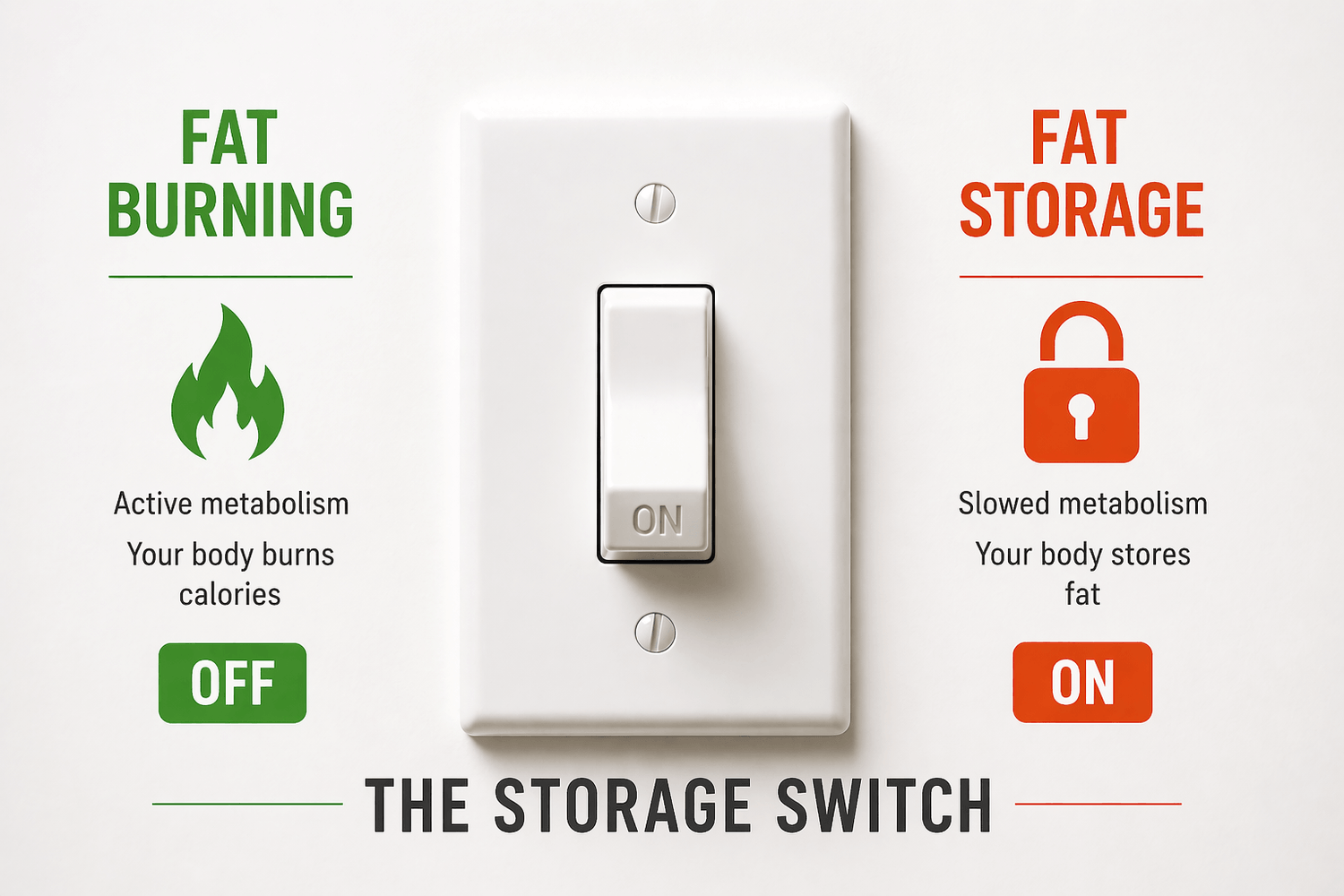
The more you tried to lose weight, the more your body became programmed to store.
The problem is not what you eat today. It's everything you did to try to lose weight yesterday.
And everything around you is designed to make things worse
There's one detail nobody ever tells you.
The diet industry is worth 250 billion dollars a year worldwide. Its business model relies on one thing: that you fail. That you come back. That you buy again.
If diets really worked, this industry would have ceased to exist 30 years ago.
Meanwhile, the food industry designs ultra-processed products specifically formulated to short-circuit your satiety signals. Hidden sugars, flavor enhancers, addictive textures, everything is optimized so that you eat more and your body stores more.
You're not at war against your weight. You're trapped between two industries that need you to stay exactly where you are.
Every day that passes, it weighs a little more

You wake up tired. Before the day has even started.
You open your wardrobe. You're not looking for something you like. You're looking for something that hides your belly. Something that shows nothing.
Your husband doesn't say anything. But you see how he looks at you. Or rather… how he doesn't look at you anymore.
You avoid group photos. When someone takes out their phone, you stand behind someone else. Or you offer to take the photo instead.
You scroll through social media. You see women your age who look good. And this thought crosses your mind:
« What are they doing differently? »
The answer: nothing. Absolutely nothing more than you. Simply, their body hasn't been locked by years of dieting.
What if your body finally stopped locking everything?
Imagine.
Your body starts burning again what you eat instead of storing everything.
You eat normally… without those cravings that push you to snack at 10pm.
And little by little, your belly starts to deflate. You wake up. You open your wardrobe and you choose your clothes because you like them. Not to hide something.
You put on your jeans. They close. Without forcing.
You look at yourself in the mirror and you don't look away.
Your husband looks at you. Really.
You go to a restaurant. You order what you feel like, without asking yourself a thousand questions.
Not because you went on yet another diet. But because your body works again the way it should.

Why I'm telling you this and why now
I've been helping women with weight management for 12 years.
During my first years, I recommended diets. Strict meal plans. Counted calories.
And I watched my clients come back 6 months later, sometimes with more kilos than when they started. It took me a long time to understand that the problem wasn't their discipline. It was the approach itself.
It was by reading the work of Leibel and Rosenbaum at Columbia those who highlighted the persistence of metabolic adaptation after a diet that I changed the way I work.
Since then, my approach is centered on metabolic regulation, not restriction. And the results I see in my clients are incomparable with what I used to see before.
I'm not telling you this to brag. I'm telling you because if it took me 12 years to understand this as a professional, I can't blame you for not knowing it.
How to restart this mechanism in your body
The question is not simply to burn more fat. The real question is:
How to act on this storage signal that years of diets have reinforced?
This is where some research started looking into solutions…
Much simpler than you'd think.
An ingredient used for millennia. Found in most kitchens. And that you may already have at home.
It's apple cider vinegar.
Here is what science has observed (not blogs, not influencers, peer-reviewed scientific journals) on appetite, digestion and certain mechanisms linked to fat storage.
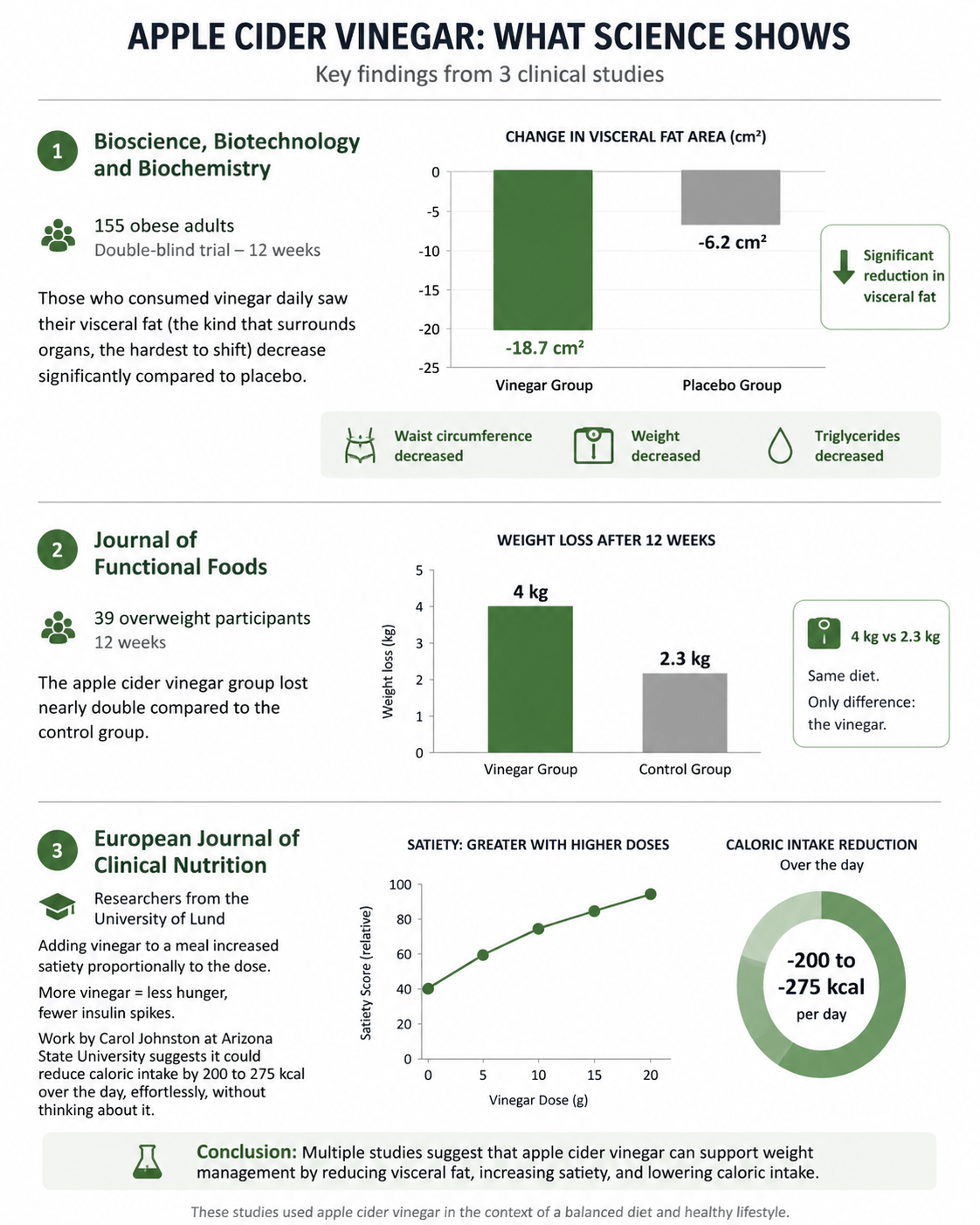
Bioscience, Biotechnology and Biochemistry:
155 obese adults followed for 12 weeks in a double-blind trial. Those who consumed vinegar daily saw their visceral fat, the kind that surrounds organs, the hardest to shift, decrease significantly compared to placebo. Their waist circumference, weight and triglycerides too.
Journal of Functional Foods:
39 overweight participants over 12 weeks. The apple cider vinegar group lost nearly double compared to the control group, 4 kg versus 2.3 kg. Same diet. Only difference: the vinegar.
European Journal of Clinical Nutrition:
Researchers from the University of Lund showed that adding vinegar to a meal increased satiety proportionally to the dose. More vinegar = less hunger, fewer insulin spikes. And work by Carol Johnston at Arizona State University suggests it could reduce caloric intake by 200 to 275 kcal over the day, effortlessly, without thinking about it.
These are real results, measured, published. And in two of these three studies, participants had changed neither their diet, nor their physical activity.
How acetic acid acts on the mechanism in 3 steps
1. It intervenes on fat metabolism.
Laboratory studies (published in PLOS One) showed that acetic acid activates an enzyme called AMPK (AMP-activated protein kinase) in muscle and liver cells the same metabolic switch that physical exercise stimulates.
When AMPK is activated, cells switch from "storage" mode to "fat-burning" mode. This mechanism has been observed in vitro and in animals and the results of human studies on vinegar (visceral fat loss, weight reduction) are consistent with this pathway.
2. It reduces cravings at the source.
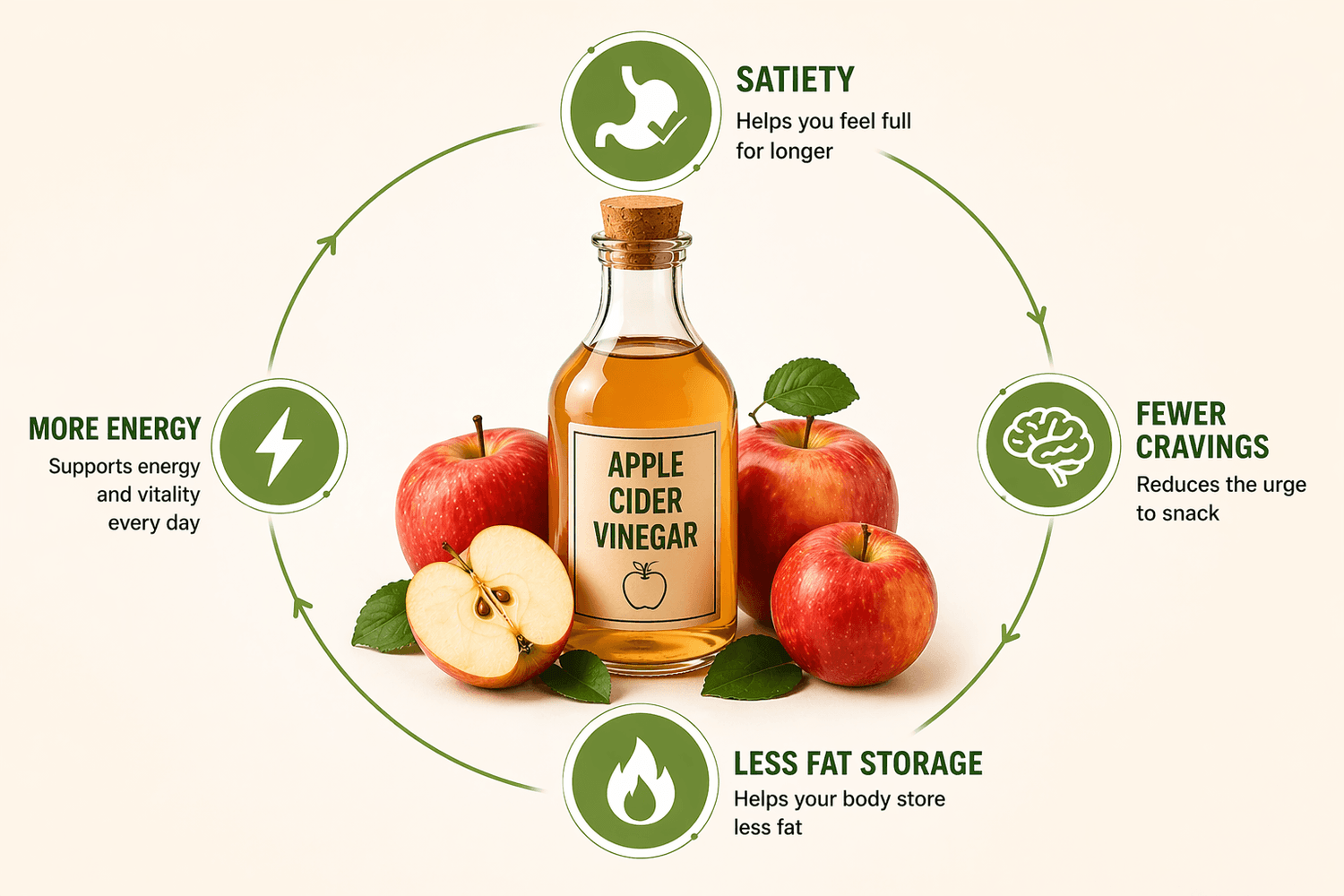
Acetic acid slows gastric emptying your stomach empties more slowly. Result: satiety lasts longer. The urge to snack at 3pm or 10pm decreases. Not through willpower. Through mechanics.
3. It stabilizes blood sugar.
Blood sugar spikes trigger insulin spikes, and insulin is the storage hormone. By smoothing these spikes, acetic acid prevents your body from receiving the repeated order to "store, store, store."
This is not magic. It's biochemistry. And that's why it works without dieting and without deprivation because it doesn't act on what you eat, but on what your body does with what you eat.
But there's a practical problem
Drinking liquid apple cider vinegar every day, in the right dosage, on a regular basis it's unpleasant. The taste is harsh.
The acidity attacks tooth enamel. And the dosages of supermarket bottles vary enormously.
However, the studies that observe certain effects use precise dosages, under controlled conditions.
That's why certain formulas have been developed, to offer a more consistent intake, easier to integrate into daily life.
It's while looking for a practical solution that Jennifer discovered this concentrated formula based on apple cider vinegar gummies, which allowed her to have the right dosage without the unpleasant taste of liquid vinegar.
It's this formula that she still uses today, and that has changed the way she manages her weight on a daily basis.
And this is often where it gets stuck
« I've already tried everything. Nothing works on me. »
This is exactly what the storage signal makes you believe. Each failure reinforces this idea. But the problem was never you. It's that nobody explained to you what was really happening in your body.
You're not a special case — you are a classic case that nobody has treated correctly.
« After 40, it's over. It's age. »
It's not age. It's the storage signal that has accumulated over years of dieting. At 30, your body still had the ability to compensate. At 40, after cycles of deprivation, it no longer compensates. This is not a curse, it's a mechanism. And a mechanism, it can be fixed.
« I don't have the willpower. I always crack. »
Willpower has nothing to do with it. When the storage signal is active, your body sends you hunger signals non-stop. You don't crack out of weakness, you crack because your biology pushes you to do it. It's not a problem of discipline. It's a problem of mechanism.
« Even if it works, I'm going to gain it all back. Like every time. »
With a diet, yes. Because a diet only reinforces the signal. Here, the goal is not to starve you. It's to act on the mechanism that causes storage. When the signal calms down, your body stops storing by default. You don't deprive yourself so there is nothing to « gain back ».
While you are reading this
This mechanism keeps going. It doesn't really stop.
And with time, it's often what makes things harder.
The more the cycles repeat… the more the body tends to stay in this storage mode.
Little by little, a kind of circle sets in. A little more storage. A little more fatigue. And this feeling that nothing really changes.
In one month: same belly. Same clothes. Same discomfort in front of the mirror. The signal a little more anchored than today.
In three months: one more diet. One more failure.
The signal a little more anchored than before.
In six months: one more size. And this growing conviction:
« This is just how it is now. »
But this is not a curse. This signal doesn't deactivate on its own.
What Jennifer did
Jennifer understood that each diet she had tried had, without wanting to, reinforced this mechanism.
She stopped fighting against her body. And she started trying to work with it.
« For the first time, I understood why nothing was working. I stopped blaming myself. It wasn't me the problem. »
Over the weeks, things started to change. Less bloating. A lighter feeling on a daily basis.
« I felt like my body was finally stopping fighting against me. I was eating more normally… and things were changing anyway. It was simple. Almost surprising. »
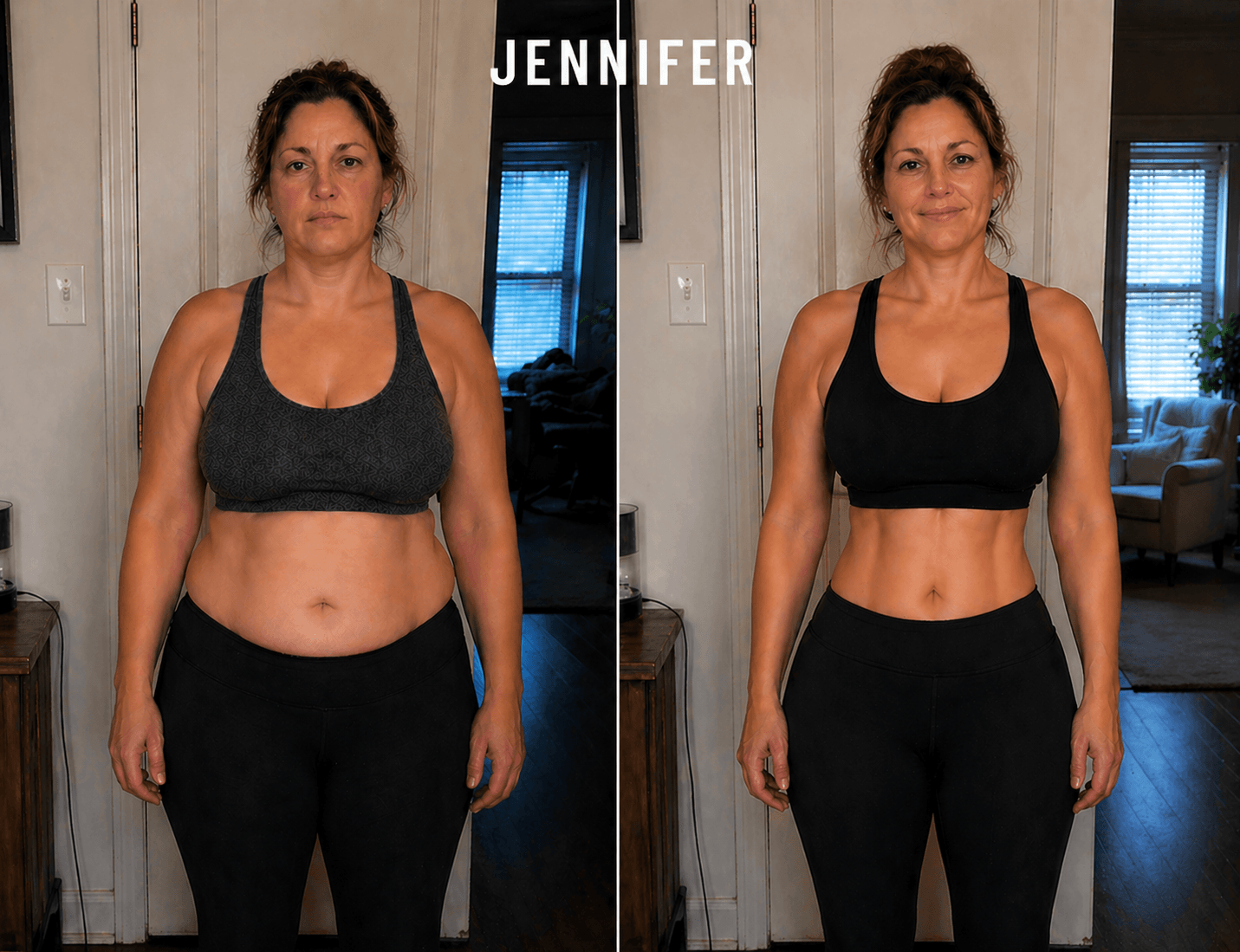
« Today, I use this formula, not to go on a diet but to keep this balance on a daily basis. »
A first step. Not yet another diet.
You have two options.
Keep going as before. Try a new diet. Lose. Gain back. Reinforce the lock. Start over.
Or understand what's really blocking and act on it.
What Jennifer did is nothing complicated. No restriction. No imposed exercise.
Just one ingredient, in the right dosage, that helps her body get out of storage mode.
Click below to discover the formula she uses.
Sources :
Journal of Functional Foods:
https://www.sciencedirect.com/science/article/abs/pii/S1756464618300483?via%3Dihub
Bioscience, Biotechnology, and Biochemistry:
https://academic.oup.com/bbb/article-abstract/73/8/1837/5947518?redirectedFrom=fulltext
European Journal of Clinical Nutrition:
https://www.nature.com/articles/1602197
Centers for Disease Control and Prevention
https://www.cdc.gov/nchs/fastats/obesity-overweight.htm?utm_source
New England Journal of Medicine:
https://pubmed.ncbi.nlm.nih.gov/22029981/
American Journal of Clinical Nutrition
https://pubmed.ncbi.nlm.nih.gov/18842775/
AMPK:
https://pmc.ncbi.nlm.nih.gov/articles/PMC4922563/
https://journals.plos.org/plosone/article?id=10.1371/journal.pone.0067880
Acetic acid:
https://pubmed.ncbi.nlm.nih.gov/9630389/
https://pubmed.ncbi.nlm.nih.gov/18093343/
Blood glucose/insulin:
https://www.nature.com/articles/1602197
The products and information found on this site are not intended to replace professional medical advice or treatment. These statements have not been evaluated by the Food and Drug Administration. These products are not intended to diagnose, treat, cure or prevent any disease. Individual results may vary.
This site is not a part of the Facebook website or Facebook Inc. Additionally, This site is NOT endorsed by Facebook in any way. FACEBOOK is a trademark of FACEBOOK, Inc.
Créer votre compte gratuit